
The Platform
The application that maps legal obligations, shows where the organization and its leaders are not defensible, guides the reasoned analysis, produces the approved plan, and creates evidence of both the decision and its implementation.
Defensible Governance™ is the first application on Defensibility.ai — The Legal Defensibility OS™. It works with the systems you already own rather than replacing them.
Category creation requires new language, so the hierarchy should be explicit.
The Legal Defensibility OS™
The management operating system that runs legal logic, role/authority mapping, jurisdiction overlays, evidence services, and applications.
Core application
Governs cybersecurity, data protection, privacy, and AI obligations through the defensibility lifecycle.
The output
A contemporaneous record of why the decision was reasonable and proof that the committed safeguards were implemented.
Why the decision was reasonable — what was known, what harm was foreseeable, which alternatives were weighed, which threshold applied, and who held authority to accept what remained.
Proof that the actions and safeguards leadership committed to were actually implemented — closing the distance between what was decided and what was done.
From obligation mapping to authenticated evidence, the application guides the decision rather than simply storing the result.
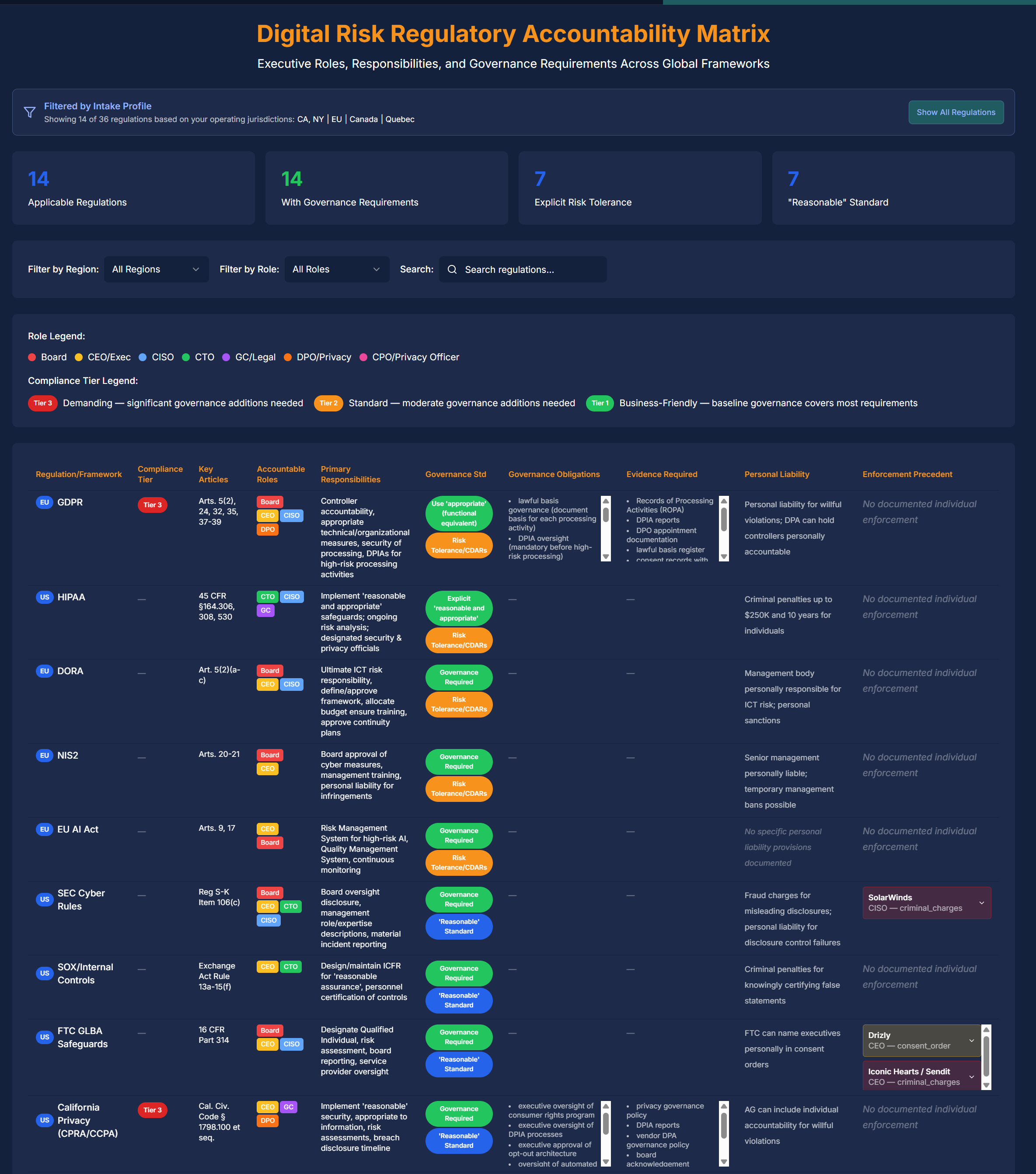
Regulatory Accountability Matrix — obligations mapped to executive roles.
Checks governance posture against the legal expectations behind reasonable, adequate, proportionate, and risk-based decision-making.
Formalizes the Calculated Definition of Acceptable Risk, alternatives, thresholds, and authority used in consequential decisions.
Preserves what was known, foreseeable harm, alternatives, proportionality, rationale, approval, and residual risk.
Time-sequenced evidentiary record of assessments, decisions, approvals, and verified implementation.
Stress-tests whether the record can answer the questions likely to be asked under scrutiny.
Shows role-specific obligations, open gaps, required decisions, and evidence posture across the C-suite.
Produces board-level exposure, alternatives, recommendations, acceptance, and approval artifacts.
Uses inputs from GRC, privacy, security, audit, and other systems to create the decision-level legal defensibility record.
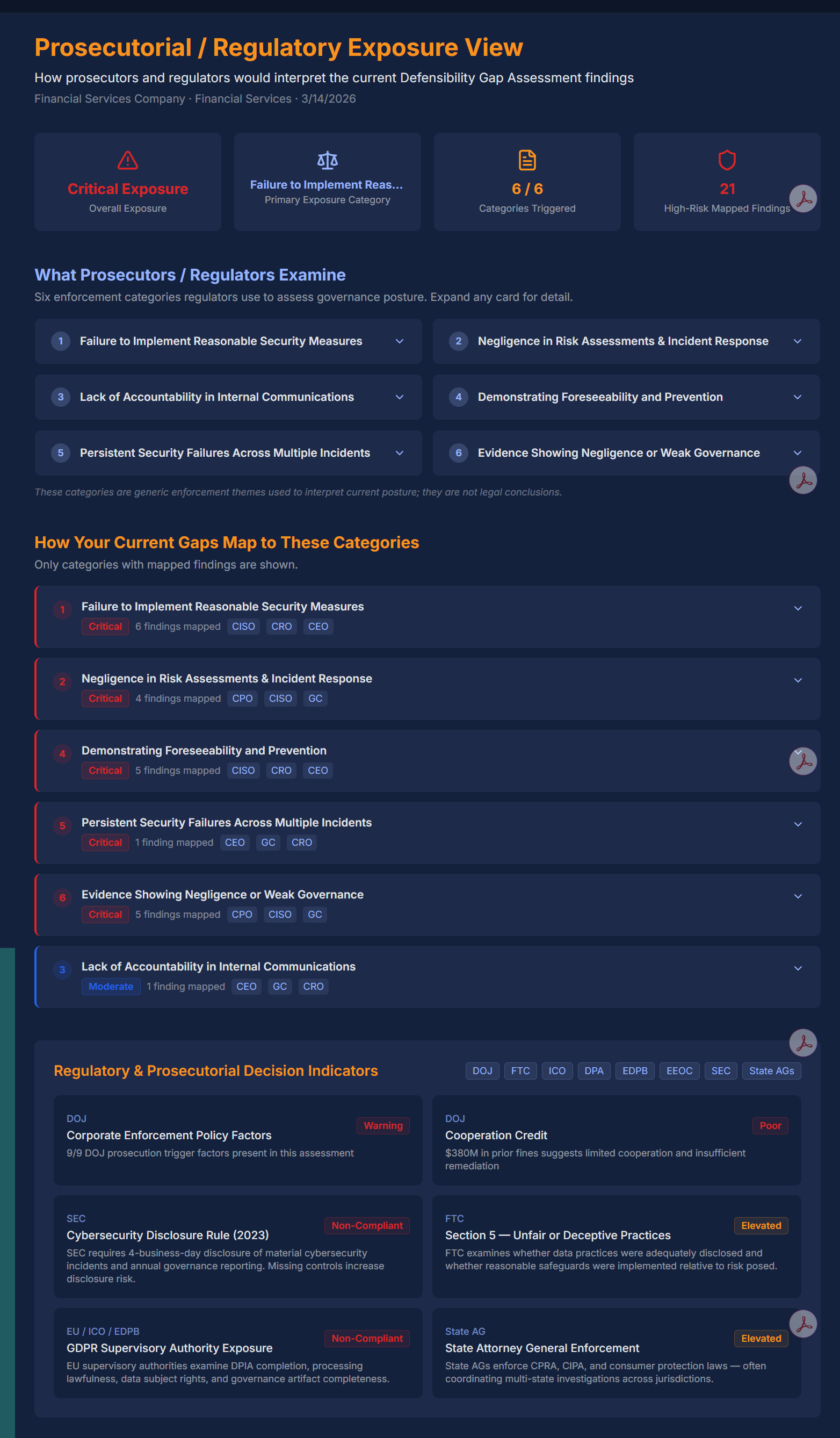
Prosecutorial / regulatory exposure view — how the posture reads under scrutiny.
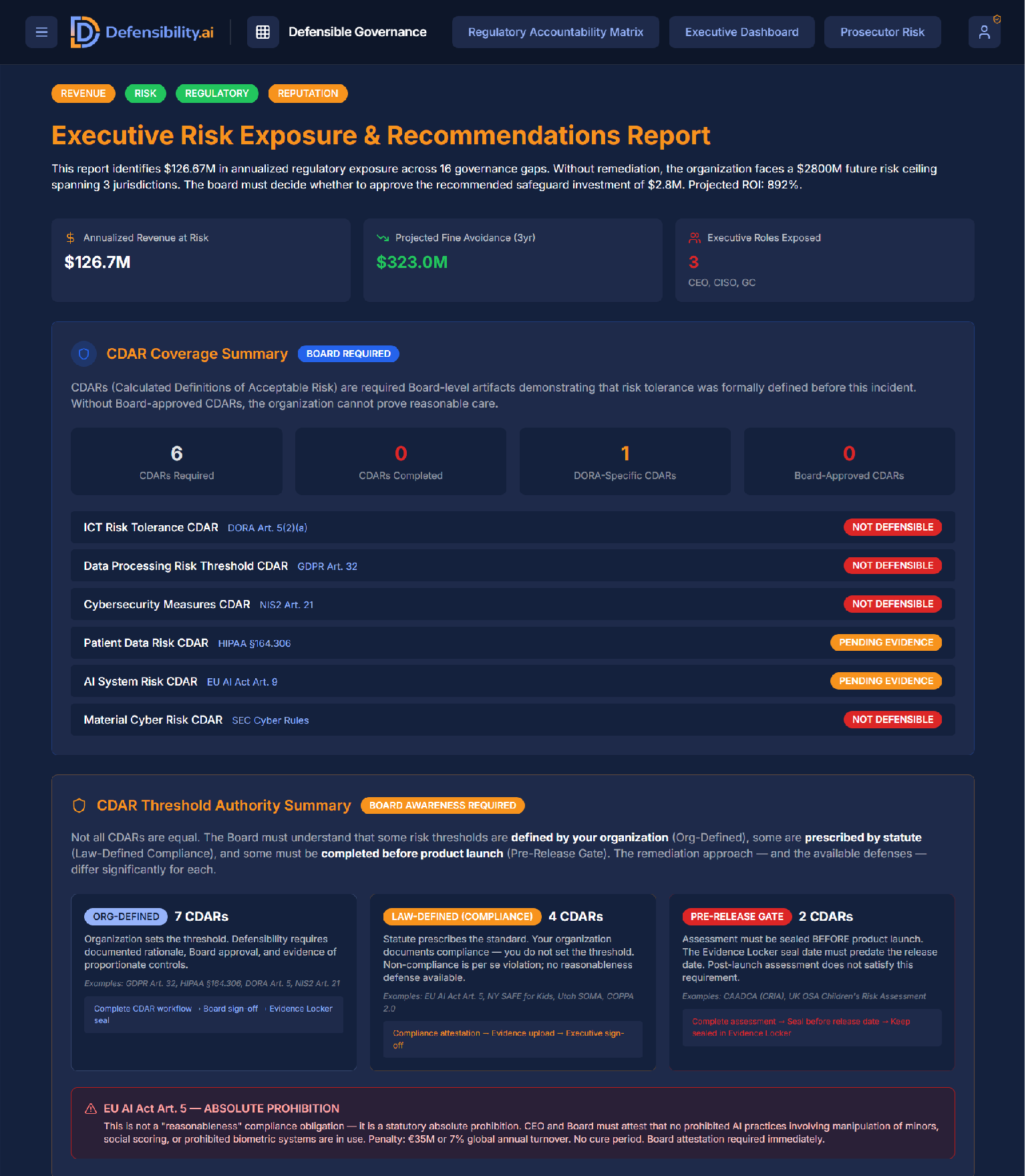
Board-Level Risk Exposure & Recommendations — what leadership reviews and approves.
The Standard, in Plain Terms
Different jurisdictions use different words, but they repeatedly test the same operational chain: what was known, foreseeable harm, available safeguards and alternatives, applicable thresholds, proportionality, authority, and evidence of implementation. Defensibility.ai operationalizes that analysis deterministically and reproducibly.
Internal risk appetite is not the same thing as an external harm threshold. The platform keeps those concepts separate and preserves the decision logic connecting them.
| Layer | What it is | Primary purpose |
|---|---|---|
| Defensible Governance Framework™ | The methodology | Defines the cross-jurisdictional decision sequence and legal-test methodology. |
| Defensibility.ai — The Legal Defensibility OS™ | The operating system | Runs legal logic, jurisdiction overlays, role/authority mapping, and evidence services. |
| Defensibility Gap Assessment Tool™ | Assessment / entry product | Shows where the organization and named leaders are not defensible and identifies missing evidence. |
| Defensible Governance™ | Core application | Runs the cyber, data-protection, privacy, and AI-governance lifecycle. |
| Minors Safety & Child Welfare | Vertical application | Applies the OS to child privacy, psychological welfare, and pre-release governance. |
The Legal Defensibility OS™ is a management operating system, not a technical runtime. It equips executive leadership, boards, counsel, risk, and governance teams with legal intelligence and a reproducible evidentiary process. It does not form an attorney-client relationship and does not provide legal advice; it equips the people who do.